American poet, writer, lawyer, professor, statesman.
(7 May 1892 - 20 April 1982)
"A real writer learns from earlier writers the way a boy learns from an apple orchard -- by stealing what he has a taste for and can carry off."
~ Archibald MacLeish, A Continuing Journey (1968)
The Snowflake Which Is Now and Hence Forever
by Archibald MacLeish
Will it last? he says.
Is it a masterpiece?
Will generation after generation
Turn with reverence to the page?
Birdseye scholar of the frozen fish,
What would he make of the sole, clean, clear
Leap of the salmon that has disappeared?
To be, yes! -- whether they like it or not!
But not to last when leap and water are forgotten,
A plank of standard pinkness in the dish.
They also live
Who swerve and vanish in the river.
Showing posts with label analecta. Show all posts
Showing posts with label analecta. Show all posts
20 June 2008

09 June 2008
Analecta Dump

Hal Higdon, "Cultural Capital"; acrylic on canvas, 48" x 36"
"It is a widely accepted notion among painters that it does not matter what one paints as long as it is well painted. This is the essence of academicism. There is no such thing as good painting about nothing."
~ Mark Rothko (1903-1970)
"Art is not what we see; it is in the spaces between."
~ Marcel Duchamp (1887-1968)
"Art evokes the mystery without which the world would not exist."
~ René Magritte (1898-1967)
"Imagination is the landscape in which the artist goes for a walk."
~ Méret Oppenheim (1913-1985)
"The paintings are the shadows of my adventures."
~ Francis Picabia (1879-1953)
Click on image to see larger version (and other works) at Hal Higdon's website. All other links in this post are to Wikipedia articles.
31 May 2008
Fill with Feelings

William Degouve de Nuncques, "The Black Swan" (1896)
Click on image to see gallery at ArtMagick.
"To make a painting, all you need to do is to take some paints, draw some lines, and fill the rest up with feelings."
~ attributed to William Degouve de Nuncques (1867-1935)
More images at History of Art.
28 May 2008
"The Realities of Life"
"Who is the artist? Is he not a human being like ourselves, with the added gifts of finer understanding and perception of the realities of life, and the ability to arouse emotions through the creation of forms and images? Surely. And this being so, those who give their lives, their knowledge and their time to social struggle have the right to expect great help from the artist. And I cannot imagine a more inspiring role than that which the artist is asked to play for the defence and advancement of civilization."
~ Paraskeva Clark, "Come Out From Behind the Pre-Cambrian Shield," New Frontier, Vol. 1, no. 12 (April 1937)
See also this excerpt (criticizing "precious, esoteric, abstract art" for being "as useful today as a top hat to a tatterdemalion beggar in the midst of winter") at the Mirabile Dictu blog.
~ Paraskeva Clark, "Come Out From Behind the Pre-Cambrian Shield," New Frontier, Vol. 1, no. 12 (April 1937)
See also this excerpt (criticizing "precious, esoteric, abstract art" for being "as useful today as a top hat to a tatterdemalion beggar in the midst of winter") at the Mirabile Dictu blog.
12 March 2008
What's Important

Giacomo Balla, "Abstract Speed: The Car Has Passed" (1913); oil on canvas
"In a way, art is a theory about the way the world looks to human beings. It's abundantly obvious that one doesn't know the world around us in detail. What artists have accomplished is realizing that there's only a small amount of stuff that's important, and then seeing what it was."
~ mathematical physicist Mitchell Feigenbaum, as quoted by James Gleick in Chaos: Making a New Science (1988)
10 March 2008
Crisis of Modernism
As a follow-up to yesterday's post about Vitaly Komar, here's a little something from his former Sots Art collaborator Alex Melamid:
Holy Hip-Hop! New Paintings by Alex Melamid
[at the Museum of Contemporary Art Detroit]
"This is the crisis of modernism. Modern art used to reflect a radical way of thinking. It did this until World War II and then it gradually became more and more established. Eventually, the radical thinking was totally removed from this. People adapted to this, said O.K. let there be, say, triangles. But in the beginning painting triangles was a huge statement, a daredevil act -- for good or for worse that's a different story, but that's how it was. But now it's totally changed its meaning because it's just a bourgeois business. You produce pictures and you sell them. You keep the form -- you can play with triangles endlessly -- but the meaning is lost, so it's a perversion of the intention of modernism. And nobody cares. The same thing happened with academic painting and ancient history. Nobody believed in it anymore, nobody cared, but still they went on depicting these beautiful women, these mythological figures. But it was totally obsolete. It lost the common sense; it lost touch with the people. Modernism was the idea to get back to some sense. Now it is senseless, so we have to revise again."Bonus Link:
~ Alex Melamid, from an interview in The Nation, 14 March 1994
Holy Hip-Hop! New Paintings by Alex Melamid
[at the Museum of Contemporary Art Detroit]
09 March 2008
Entertainment + Questions

Vitaly Komar, "Big Red Moustache," from Three-Day Weekend
(2004-05); mixed media on paper, 40" x 30"
"Of course some art is entertaining, looks like entertainment, but the most important thing is to bring the questions in people's minds. If art is entertainment which raises new questions, I'm for that. But if art just answers questions, it's nothing but propaganda."
~ Vitaly Komar (b. 1943)
Links:
- Three-Day Weekend
- Three-Day Weekend reviewed by Donald Goddard
- Three-Day Weekend at Idlehacker
- Sots Art (Soviet Pop)
- Vitaly Komar and Alex Melamid
- Painting by Numbers: Komar and Melamid's scientific guide to art
- Komar & Melamid: The Most Wanted Paintings (a hoot: bring on the blue landscapes!)
08 March 2008
Connecting
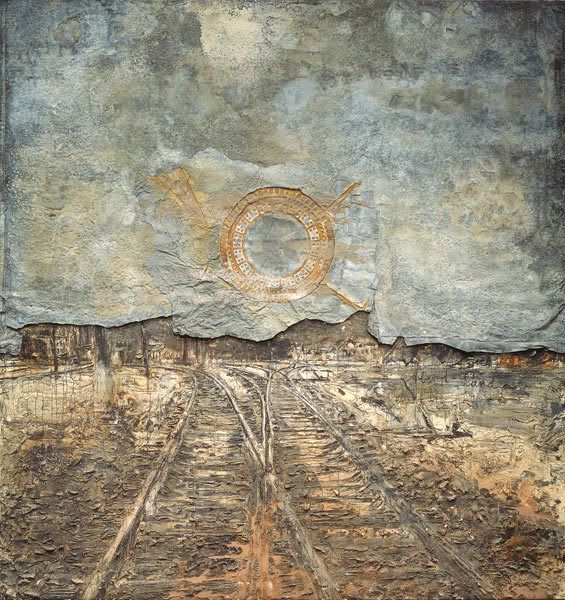
"I'm interested in reconstructing symbols. It's about connecting with an older knowledge and trying to discover continuities in why we search for heaven."
~ Anselm Kiefer (born 8 March 1945)

Anselm Kiefer, "Abendland (Twilight of the West)" (1989);
synthetic polymer paint, ash, plaster, cement, earth, varnish
on canvas and wood, approx. 13' 2" x 12' 6"
Click on image to see larger version in a new window.
~ Anselm Kiefer (born 8 March 1945)
Anselm Kiefer, "Abendland (Twilight of the West)" (1989);
synthetic polymer paint, ash, plaster, cement, earth, varnish
on canvas and wood, approx. 13' 2" x 12' 6"
Click on image to see larger version in a new window.
- Anselm Kiefer at White Cube
- Anselm Kiefer: Heaven and Earth
- Anselm Kiefer: Works on Paper 1969-1993
05 March 2008
Business is Business
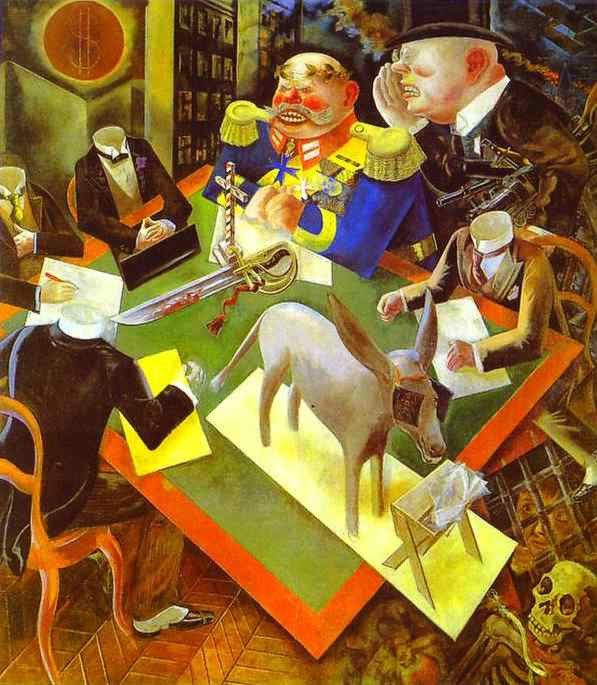
George Grosz, "Eclipse of Sun" (1926); oil on canvas, approx. 82.5" x 72.5"
Click on image to see larger version in a new window.
"The cult of individuality and personality, which promotes painters and poets only to promote itself, is really a business. The greater the 'genius' of the personage, the greater the profit."
~ George Grosz (1893-1959)
Link:
George Grosz at MoMA
04 March 2008
Wards and Cells
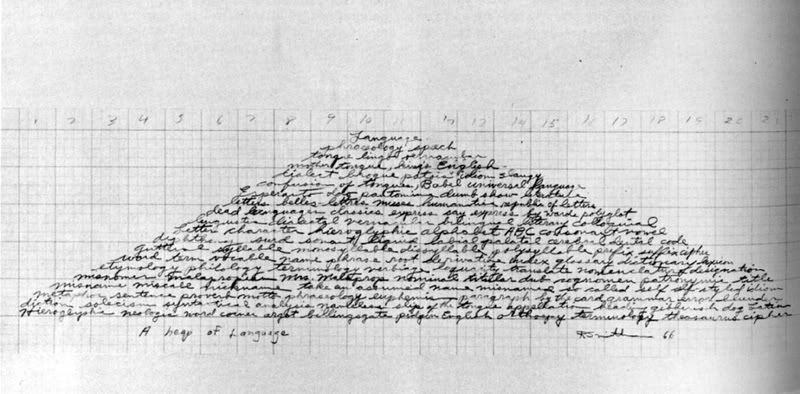
Robert Smithson, "A Heap of Language" (1966); pencil on paper, 6.5" x 22"
Click on image to see larger version in a new window.
"Artists themselves are not confined, but their output is. Museums, like asylums and jails, have wards and cells -- in other words, neutral rooms called 'galleries.' A work of art when placed in a gallery loses its charge, and becomes a portable object or surface disengaged from the outside world."
~ Robert Smithson (1938-1973), from "Cultural Confinement"
Link:
Robert Smithson website
03 March 2008
The Memory of Time

Daido Moriyama, "Fly, Suwa City, Nagano" (1982); gelatin silver print, 14" x 17"
"A photograph is the result of a momentary thought, with the result that you are always experimenting and interpreting the streets and buildings of a city by using the reproduction equipment -- the camera -- in order to get beyond known languages and to develop another reality running counter to the incessant flow of time. If this is achieved, the image captured in the photograph transcends the limited imagination or the ego of the photographer and becomes a symbol that signifies a world and includes the memory of time."
~ Daido Moriyama (b. 1938)
Link:
Daido Moriyama at Tepper Takayama Fine Arts
02 March 2008
Questions
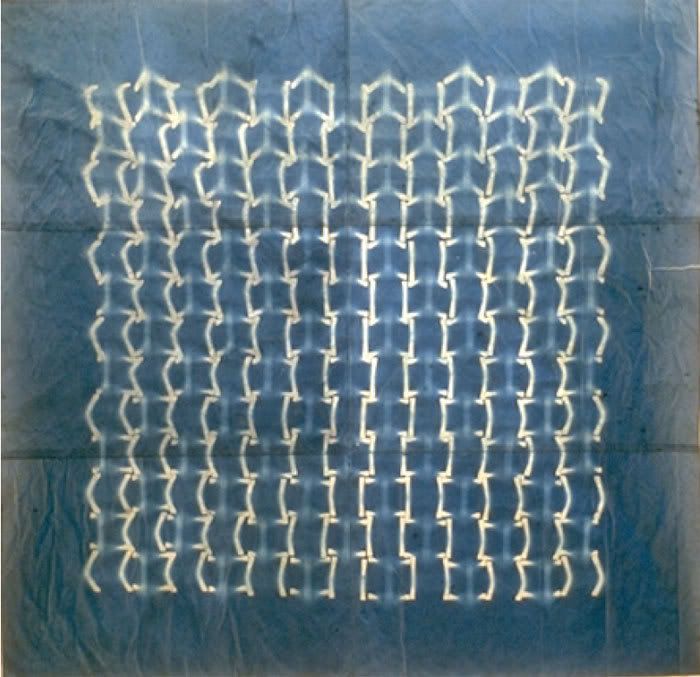
Robin Hill, "place sawhorses on paper. expose to light. wait."
(1997); cyanotype on paper, 60" x 60"
Click on image to see larger version in a new window.
"I think the way artists talk about their work says a lot about how they think as artists. It doesn't really matter whether or not they're good public speakers. That's not the issue. What's interesting is whether they talk only about their most recent work. Do they talk about it chronologically? Do they talk about their work thematically? Do they separate the drawings from the painting and the sculpture? How an artist goes about structuring a presentation tells you so much about the work itself. I think it's important to give your public an opportunity to see what you're struggling with and what you're trying to define for yourself, what questions you are asking yourself."
~ Robin Hill, in an interview with Ron Janowich, published in Other Voices (May 2007)
Link:
Robin Hill website
27 February 2008
Breakthroughs

Helen Frankenthaler, "The Bay" (1963); acrylic on canvas
"There are no rules. That is how art is born, how breakthroughs happen. Go against the rules or ignore the rules. That is what invention is about."
~ Helen Frankenthaler
Bonus Link:
The Wrigley School of Art Criticism
Twelve-year-old boy ignores rules; no art born.
25 February 2008
The Struggle
"The painters and sculptors of today cannot remain indifferent in the struggle to free humanity and art from oppression."
~ David Alfaro Siqueiros (1933)

David Alfaro Siqueiros, "Después De La Grand Tormenta [After the Great Storm]"
(1966); pyroxolin on masonite, 12" x 18"
Click on image to see larger version in a new window.
Links:
It is interesting to note that 75 years after his statement about freeing art from oppression (and 34 years after his death), many images of Siqueiros' work have been removed from the web at the request of a "copyright collective" which presents itself as "an artists [sic] rights organization." Siqueiros may have been on to something when, in 1922, he wrote "We repudiate so-called easel painting and every kind of art favored by the ultra-intellectual circles, because it is aristocratic and we praise monumental art in all its forms, because it is public property."
~ David Alfaro Siqueiros (1933)
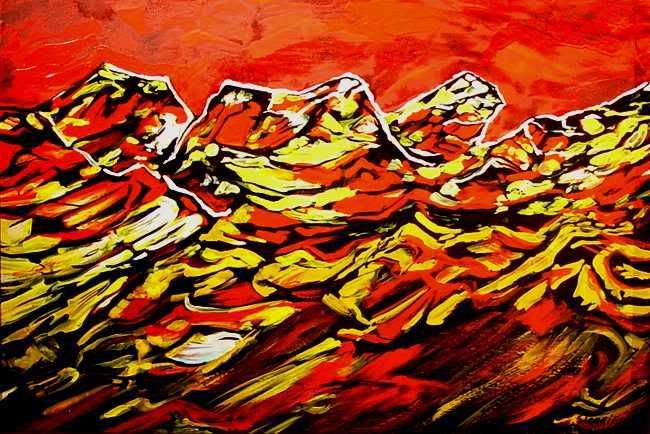
David Alfaro Siqueiros, "Después De La Grand Tormenta [After the Great Storm]"
(1966); pyroxolin on masonite, 12" x 18"
Click on image to see larger version in a new window.
Links:
- The Artist as Activist: David Alfaro Siqueiros (1896 - 1974)
- David Alfaro Siqueiros at Humanities Web
- David Alfaro Siqueiros at MoMA
- Philip Stein's biography, Siqueiros: His Life and Works
- David Alfaro Siqueiros at Wikipedia
It is interesting to note that 75 years after his statement about freeing art from oppression (and 34 years after his death), many images of Siqueiros' work have been removed from the web at the request of a "copyright collective" which presents itself as "an artists [sic] rights organization." Siqueiros may have been on to something when, in 1922, he wrote "We repudiate so-called easel painting and every kind of art favored by the ultra-intellectual circles, because it is aristocratic and we praise monumental art in all its forms, because it is public property."
24 February 2008
Being More Human
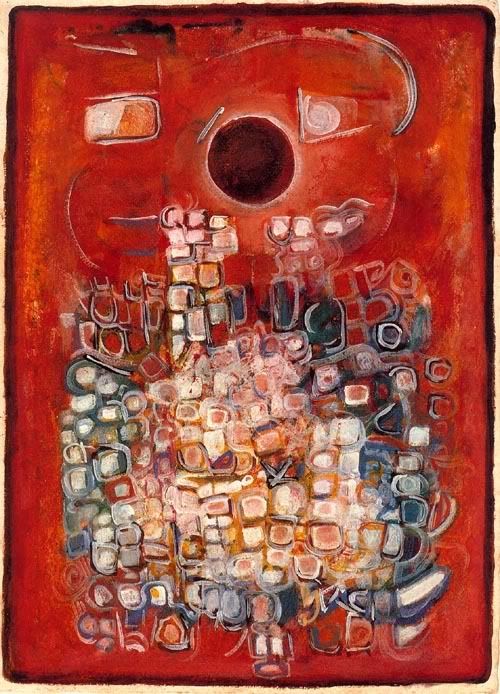
David C. Driskell, "Movement, The Mountain"
(1980), egg tempera on canvas, 31.20" x 22.70"
Click on image to see larger version in a new window.
"I've always felt that art was a special or particular calling. I've even described it as being priestly in function... I do think that [as an artist] I am being more human and extending my humanity to others."
~ David C. Driskell (b. 1931), from "A Conversation between David Driskell and Richard Klank," as quoted in David C. Driskell: Artist and Scholar, by Julie L. McGee (2006)
21 February 2008
The Philosophers' Rebellion
"Every significant artist is a metaphysician, a propounder of beauty-truths and form-theories."
~ Aldous Huxley (1894-1963)
"All art is a revolt against man's fate."
~ André Malraux (1901-1976)
~ Aldous Huxley (1894-1963)
"All art is a revolt against man's fate."
~ André Malraux (1901-1976)
Art Machine

Sol LeWitt, "Brushstrokes" (2000); gouache on paper, 22.5" x 29.5"
Click on image to see larger version in a new window.
"The idea becomes a machine that makes the art."
~ Sol LeWitt (1965)
Links:
- Sol LeWitt: obituary in New York Times (9 April 2007)
- Sol LeWitt: retrospective at San Francisco Museum of Modern Art (February - May, 2000)
- Sol LeWitt: "Sentences on Conceptual Art" (1969)
19 February 2008
Spontaneous Expression
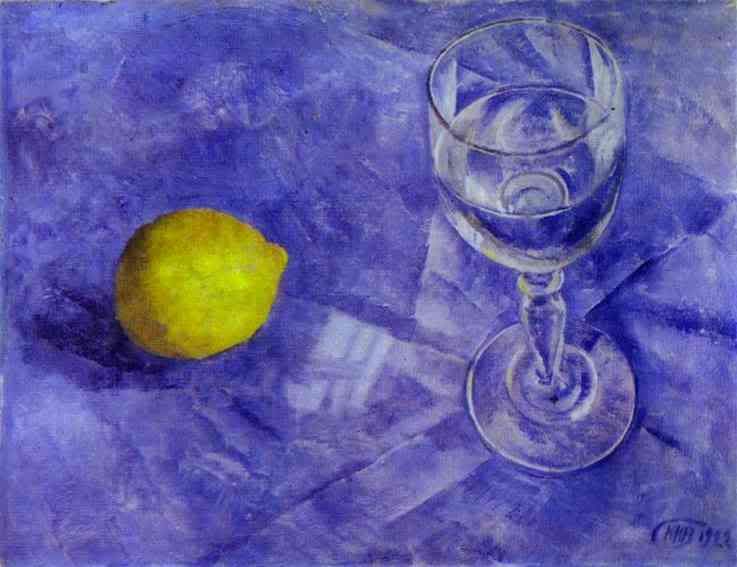
Kuzma Petrov-Vodkin, "Lemon and Glass" (1922); oil on canvas, approx. 14.5" x 19"
Click on image to see larger version in a new window.
"That word, 'art', is that what made the essence of my disagreement with ... all the rules and habits -- secular, academic, and iconographic; already as a boy I wanted the free, full, frank and spontaneous expression, which makes art."
~ Kuzma Petrov-Vodkin, from Prostranstvo Evklida (Euclid's Space, transl. Yuri Mataev)
16 February 2008
Whatchamacallit
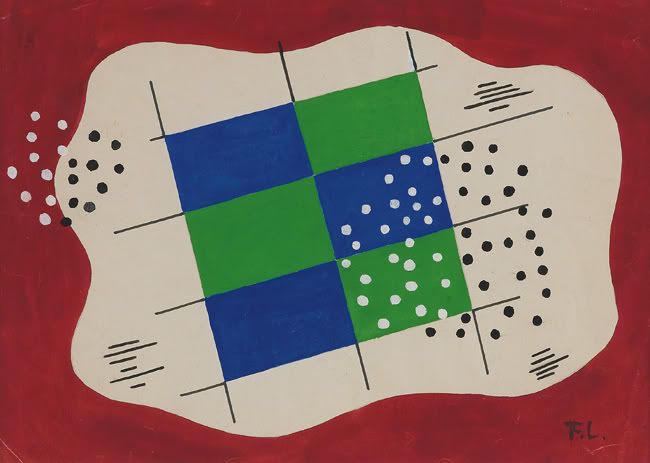
Fernand Léger, "Project Tapisserie" (circa 1945); gouache on paper, 9" x 12.25"
Click on image to see larger version in a new window.
"What does that represent? There was never any question in plastic art, in poetry, in music, of representing anything. It is a matter of making something beautiful, moving, or dramatic -- this is by no means the same thing."
~ Fernand Léger (1881-1955)
09 February 2008
Choosing. Preferring. Judging.
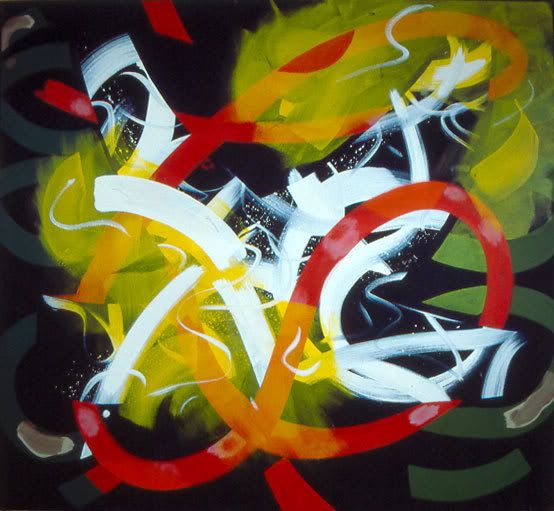
Richard Hennessy, "Leaping Laocoön" (1985); oil on canvas, 60" x 66"
Click on image to see larger version in a new window.
"... [N]o matter how long you have painted, no matter how much experience you have accumulated, you can never completely predict what the mark you make with your brush will look like. You make the mark and then you have to react to it. And your reaction may not be immediate. It may take a while -- for me, at any rate, because I never start with a plan for how to proceed.... A painting acquires interest by becoming a record of the interaction of mind, matter, and physical activity. Choosing. Preferring. Judging. Making."~ Richard Hennessy (b. 1941), from a conversation with Carter Ratcliff, in The Sienese Shredder #2
Reference:
- Laocoön in Greek mythology.
- William Blake's "Laocoön"
- 500th Anniversary of the Finding of the Laocoön on the Esquiline Hill in Rome (2006: Institute of Design & Culture, Rome)
Subscribe to:
Posts (Atom)

