Showing posts with label cogitation. Show all posts

16 May 2008

Big Questions

Should philosophy have something to say to non-philosophers? Should philosophy be pursued only by those trained in philosophy? Should academic teachers of philosophy consider themselves philosophers in virtue of the fact that they teach philosophy? And should analytic philosophers deny that continental philosophers are philosophers at all, or acknowledge that they represent different modes of philosophizing? Cogito poses some big questions to four prominent British and US philosophers.
(via wood s lot)

Which got me to wondering...
Should art have something to say to non-artists? Should art be pursued only by those trained in art? Should academic teachers of art consider themselves artists in virtue of the fact that they teach art? And should formalist artists deny that conceptual artists are artists at all, or acknowledge that they represent different modes of art-making?

Or, since some painters resist the label "artist":
Should painting have something to say to non-painters? Should painting be pursued only by those trained in painting?

Or, in a literary vein:
Should poetry have something to say to non-poets? Should poetry be pursued only by those trained in poetry?

17 February 2008

Aesthetic: Experience

Photo Sharing at Photobucket
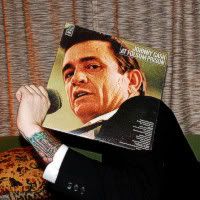
sleeveface: "one or more persons obscuring or augmenting any part of their body or bodies with record sleeve(s) causing an illusion."

.o0O0o.

The Annotated Grateful Dead Lyrics, by David Dodd
Project begun: January, 1995.
Suspended: June 26, 2007.

Where else could you find an essay on "'Dark Star' as an Example of Transcendental Aesthetics":
"Developed largely from the ideas of Schopenhauer, and later in the early 20th century by [Bennedetto] Croce and [R. G.] Collingwood, this theory sees art as that which produces a holistic sense of 'going beyond' normal life experiences. This transcendence is called the aesthetic experience and things that cause the aesthetic experience are called art."
~ by Steven Skaggs

.o0O0o.

Mr. Skaggs seems to espouse the aesthetic philosophy known as Expressionism. I might be mistaken; I'm new at this.

Five Philosophies of Aesthetics
~ adapted from Lesson Seven ("Should Art Be For Art's Sake") of Protest And Persuasion, at Chicana and Chicano Space; clearly this list is specific to the visual arts.
  • Imitationalism: Good art imitates the appearance of things. Art should be realistic: it should look like something.
  • Formalism: Good art affects its viewers because of the relationship among the visual elements in the artwork (lines, shapes, colors, values [lights and darks], textures, volume, and space). It's interesting to look at. Art is valuable in itself -- art for art's sake.
  • Expressionism: Good art expresses the emotions of the maker and has an emotional impact on its viewers. Art is about emotions.
  • Instrumentalism: Art should lead to some social good. Art has a function: it does something.
  • Institutionalism: Good art is determined by the responses of people with authority in the artworld (artists, critics, curators, scholars, teachers, etc.). Art is what art experts say it is.
.o0O0o.

Something that caught my eye while skimming over Joseph Kosuth's "Art After Philosophy" (1969): his parenthetical mention of "the apparent other 'functions' of art":
  1. depiction of religious themes,
  2. portraiture of aristocrats,
  3. detailing of architecture,
  4. etc.
Hmm... An interesting set of possibilities, especially when one considers what constitute the "religious themes" and "aristocrats" of our own culture, here and now. Not the conventional definitions of "religion" or "aristocracy," but what institutions in our own era truly function as analogs to the pre-Industrial concepts represented by those words.

I suspect, for example, that the genuine "religious themes" of present-day American culture are better represented by the advertising industry than by any nominally religious institution.

And what's hiding behind that "etc." at the end of the list? You have piqued my curiosity, Mr. Kosuth! I've been reading John Berger's Ways of Seeing, so I have all kinds of crazy ideas.

29 December 2007

Because I need to hear it...

"If we lived in a State where virtue was profitable, common sense would make us good, and greed would make us saintly. And we'd live like animals or angels in the happy land that needs no heroes. But since in fact we see that avarice, anger, envy, pride, sloth, lust and stupidity commonly profit far beyond humility, chastity, fortitude, justice and thought, and have to choose, to be human at all … why then, perhaps we must stand fast a little -- even at the risk of being heroes."
~ the character Sir Thomas More, in Robert Bolt's A Man for All Seasons

Incidentally, it's interesting to note that the somewhat abbreviated version of this speech in the 1966 film adaptation omits envy, sloth and lust among the vices, and substitutes charity and modesty for the virtues humility, chastity and fortitude. Hmmm...

20 September 2007

Intention

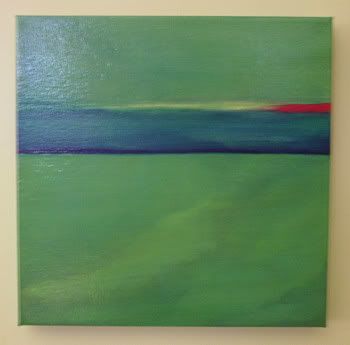
(Recent photographs; click to see full-size image in new window)

What am I [wanting/trying] to [say/do] with my work?
Does it matter?
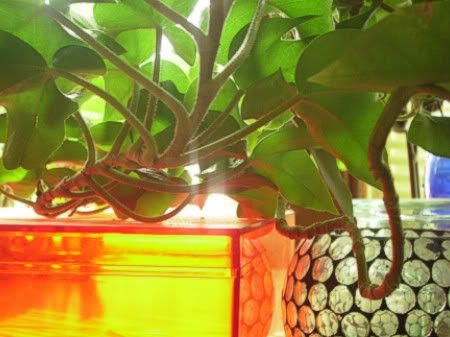
Photo Sharing at Photobucket

When it comes to the bricolage I post here, my intention is relatively clear to me, and (for lack of a better word) "automatic." I don't feel the need to hold in mind a clear statement of What I'm Trying to Do, because I've been working with text long enough to know both what I'm doing and how I'm doing it.
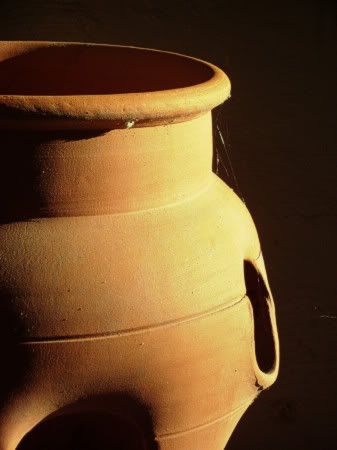
Photo Sharing at Photobucket

With the bricolage, I have that kind of vanity described by Rex Crockett in this post from Art & Perception:
"Sometimes when no one loves you, vanity is a wonderful thing. At times, it is even good to be self deluded. Seeing your own work as worthwhile, even great, when no one else does can be all you have. Vanity can get you through hard times. Vanity is useful. It is a survival tool."
I recognize that almost no one else "gets" it, but I'm vain (or deluded!) enough to be certain of its value.
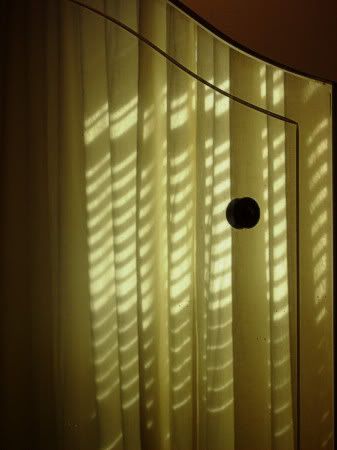
Photo Sharing at Photobucket

In the case of photography, my intention is almost passive: I'm hardly trying to say/do anything at all. I just record what is visually interesting to me, without much creative decision-making. I don't use artificial lighting or filters, I don't set up arranged tableaux, and I use cameras that permit me only minimal control over aperture and exposure time.

For the most part, all I control is framing and composition. And I know enough about the traditional standards of composition to recognize when a particular shot is worthwhile, or when the resulting photograph is "good." My intention is more documentary than expressive or creative.
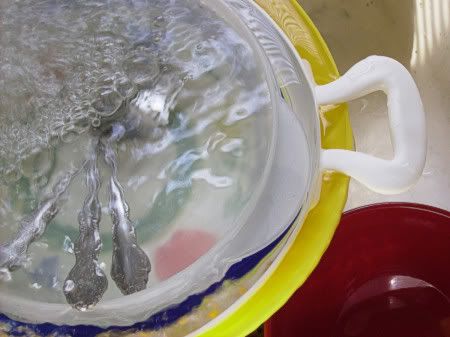
Photo Sharing at Photobucket

But when it comes to painting, I'm stumped -- often and enduringly. What am I trying to do?

I haven't internalized that sense of what I'm doing and how I'm doing it. I don't have that useful vanity to push me along without others' approval. And painting can never be as passively receptive as point-&-click photography. Even if it were that easy, I aspire to something more than documentary record-making.
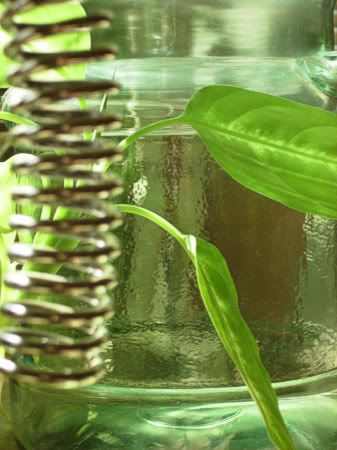
Photo Sharing at Photobucket

For the past 18 months or so, I've been engaged with painting more as process art than anything else -- opening myself to the notions of a "creative journey," serendipitous effects, a sense of playfulness or experimentation with the materials. But today, looking over the completed work, the journey seems like a solipsistic dead-end, the serendipity feels more like folly, the playfulness indulgent. Even with those 2 or 3 works I like, I find myself asking: is this at all valid (or worthwhile or meaningful or relevant or even just beautiful)?

What am I trying to do? What am I wanting to say?
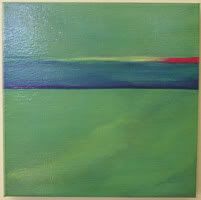
Photo Sharing at Photobucket

Does it matter?

In his blog On Painting, Duane Keiser says that "... a painterly aesthetic develops when the way we like to move paint begins to mesh with our sense of what is beautiful." I like that sentiment, but as I look at yet another blank canvas this morning, I feel like I want something else or something more.