Stan Brakhage:
"I always liked best what Hollis Frampton said (a great filmmaker, Hollis Frampton, a teacher and an aesthetician as both of us hoped to be). He said the whole history of Hollywood movies, any movies, was comparable to birdsong. He discovered after years of listening to the birds that there are only five things that birds say, and he discovered that there are only five things that movies do. They say 'Good morning!' 'I found a worm.' 'Love me.' 'Get out!' 'Good night.'"
What Hollis Frampton actually said:
"One fine morning, I awoke to discover that, during the night, I had learned to understand the language of birds. I have listened to them ever since. They say: 'Look at me!' or: 'Get out of here!' or: 'Let's fuck!' or: 'Help!' or: 'Hurrah!' or: 'I found a worm!' and that's all they say. And that, when you boil it down, is about all we say. (Which of those things am I saying now?)"
~ from Circles of Confusion: Film, Photography, Video: Texts 1968-1980
11 June 2008

09 June 2008
Analecta Dump
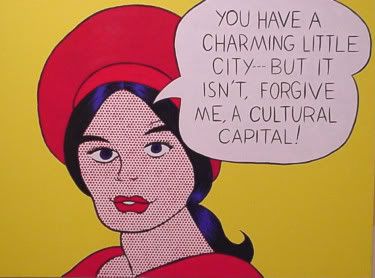
Hal Higdon, "Cultural Capital"; acrylic on canvas, 48" x 36"
"It is a widely accepted notion among painters that it does not matter what one paints as long as it is well painted. This is the essence of academicism. There is no such thing as good painting about nothing."
~ Mark Rothko (1903-1970)
"Art is not what we see; it is in the spaces between."
~ Marcel Duchamp (1887-1968)
"Art evokes the mystery without which the world would not exist."
~ René Magritte (1898-1967)
"Imagination is the landscape in which the artist goes for a walk."
~ Méret Oppenheim (1913-1985)
"The paintings are the shadows of my adventures."
~ Francis Picabia (1879-1953)
Click on image to see larger version (and other works) at Hal Higdon's website. All other links in this post are to Wikipedia articles.
31 May 2008
Fill with Feelings
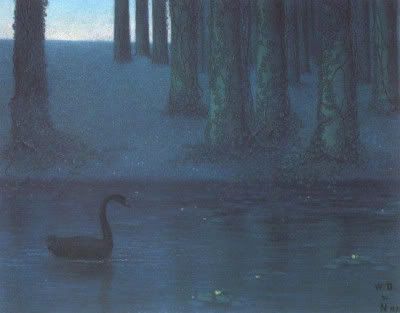
William Degouve de Nuncques, "The Black Swan" (1896)
Click on image to see gallery at ArtMagick.
"To make a painting, all you need to do is to take some paints, draw some lines, and fill the rest up with feelings."
~ attributed to William Degouve de Nuncques (1867-1935)
More images at History of Art.
29 May 2008
The Darkness
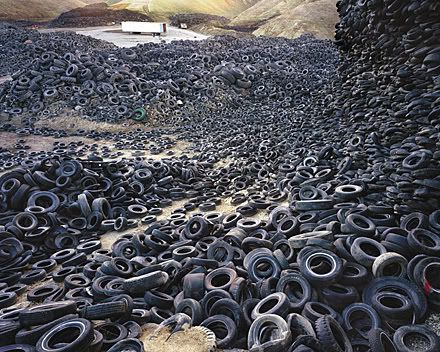
Edward Burtynsky, "Oxford Tire Pile No. 1" (Westley, California 1999)
"Filling the conscious mind with ideal conceptions is a characteristic of Western theosophy, but not the confrontation with the shadow and the world of darkness. One does not become enlightened by imagining figures of light, but by making the darkness conscious."
~ Carl G. Jung, "The Philosophical Tree" (1945), in Collected Works 13: Alchemical Studies
"These images are meant as metaphors to the dilemma of our modern existence; they search for a dialogue between attraction and repulsion, seduction and fear. We are drawn by desire -- a chance at good living, yet we are consciously or unconsciously aware that the world is suffering for our success. Our dependence on nature to provide the materials for our consumption and our concern for the health of our planet sets us into an uneasy contradiction. For me, these images function as reflecting pools of our times."
~ Edward Burtynsky, "Exploring the Residual Landscape" (artist statement)
28 May 2008
"The Realities of Life"
"Who is the artist? Is he not a human being like ourselves, with the added gifts of finer understanding and perception of the realities of life, and the ability to arouse emotions through the creation of forms and images? Surely. And this being so, those who give their lives, their knowledge and their time to social struggle have the right to expect great help from the artist. And I cannot imagine a more inspiring role than that which the artist is asked to play for the defence and advancement of civilization."
~ Paraskeva Clark, "Come Out From Behind the Pre-Cambrian Shield," New Frontier, Vol. 1, no. 12 (April 1937)
See also this excerpt (criticizing "precious, esoteric, abstract art" for being "as useful today as a top hat to a tatterdemalion beggar in the midst of winter") at the Mirabile Dictu blog.
~ Paraskeva Clark, "Come Out From Behind the Pre-Cambrian Shield," New Frontier, Vol. 1, no. 12 (April 1937)
See also this excerpt (criticizing "precious, esoteric, abstract art" for being "as useful today as a top hat to a tatterdemalion beggar in the midst of winter") at the Mirabile Dictu blog.
25 May 2008
Masks
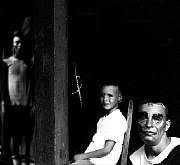
Ralph Eugene Meatyard, "Here-in-after, here-in-before"
(1963); gelatin silver print, approx. 6.5" x 7.25"
(Click on image to see more of Meatyard's work at George Eastman House)
"If you want to say something and have people listen then you have to wear a mask. If you want to be honest then you have to live a lie."
~ Banksy, Existencilism (2002)
"Man is least himself when he talks in his own person. Give him a mask, and he will tell you the truth."
~ Oscar Wilde, "The Critic as Artist" (1891)
16 May 2008
Big Questions
Should philosophy have something to say to non-philosophers? Should philosophy be pursued only by those trained in philosophy? Should academic teachers of philosophy consider themselves philosophers in virtue of the fact that they teach philosophy? And should analytic philosophers deny that continental philosophers are philosophers at all, or acknowledge that they represent different modes of philosophizing? Cogito poses some big questions to four prominent British and US philosophers.(via wood s lot)
Which got me to wondering...
Should art have something to say to non-artists? Should art be pursued only by those trained in art? Should academic teachers of art consider themselves artists in virtue of the fact that they teach art? And should formalist artists deny that conceptual artists are artists at all, or acknowledge that they represent different modes of art-making?
Or, since some painters resist the label "artist":
Should painting have something to say to non-painters? Should painting be pursued only by those trained in painting?
Or, in a literary vein:
Should poetry have something to say to non-poets? Should poetry be pursued only by those trained in poetry?
Subscribe to:
Posts (Atom)

